Thursday, June 11, 2015

Oysters

Hi Sea Fans!

You might think that they are ugly, have a horrible texture when in your mouth and they don't seem to do much...but you're wrong!  Oysters are high in calcium, iron and protein and once you've got past the 'ickyness" of the flesh, they're quite tasty.  Ask all the posh people, they love to eat oysters :)

I don't want to talk about eating my ocean buddies though, I want to tell you about the Oyster Recovery Partnership (ORP) who I visited recently.  I got to have a look at what they are doing to help the Chesapeake Bay.
Me with Flat Shelly, the ORP mascot.
Let's first find out a bit more about oysters though:

There are true oysters (food oysters) and pearl oysters, but the food oysters can produce pearls too.  Oyster shells are usually pear or oval in shape, but it depends on what they attach themselves to.  I've seen a few that can't be described as any shape!  They have a whitish-grey outside shell and on the inside they have a porcelain white inside shell.  They've got strong muscles that close their shells when they are threatened and they feed by drawing water over their gills and eating the titbits floating around in the water.

Each adult oyster, on average, filters 189 litres (50 gallons) of water a day! Check out this video which shows you how these filter feeders clean up the water:
https://youtu.be/1Zm-yMpHsaQ

Not only do oyster reefs purify the water, but they also create ideal habitats (homes) for a number of other animals (crabs, fish etc).  This is why ORP is getting people together to restore oyster reefs:
https://youtu.be/U8TNeusghYs

In order to restore the reefs though, they need shells for the spat (baby oysters) to grow on,
so ORP came up with shell recycling where restaurants get involved by collecting their used oyster shells for the reefs.
Collected oyster shells.
A ship full of oyster shells about to wash them overboard to make another reef.
What a great idea!

I ended my visit with ORP by taking a visit to the Horn Point Lab hatchery in Cambridge, MD - which is the world's largest oyster hatchery of the species called C. virginica.  I couldn't believe it when I learnt that in the 2014 oyster planting season, over 800 million spat-on-shell was produced in the lab and planted back in the local waterways!

ORP work together with scientists to learn better ways to grow oysters and restore oyster reefs, they teach the public how they can help and they work with those people who make the laws so that oyster restoration is encouraged.  I love it when people work together to help our animals!  

If you'd like to find out more, go to: http://www.oysterrecovery.org/

Thanks to Bryan Gomes for having me.

Have a great week Sea Fans!
Chat soon.

Cheers.
Abby
}( *)8

Tuesday, May 26, 2015

Stinky!

Hi Sea Fans!

How funny...I've just been past the fish kitchen and saw a whole bunch of kids
on a behind-the-scenes tour holding their noses!  They think that it stinks - ha
ha ha!  We've all gotten so used to the smell of fish that we don't smell it
anymore.  Fresh fish doesn't smell fishy, but our fish bins that have been sitting
with old bits in for a day don't smell as fresh.

That smell must really stick to us because I've even had a shopkeeper crinkle
up her nose and sniff the air like there's something stinky when I've gone to pay
for something - not great, but if she knew what I got to do all day, I'm sure
she'd wish she could smell like me! : )  Smelling like fish is a small price to pay
when you get to work with turtles,
A baby turtle we rehabilitated and released back into the sea when it was bigger.
penguins,
Watching a baby penguin grow up is so fulfilling and rewarding.
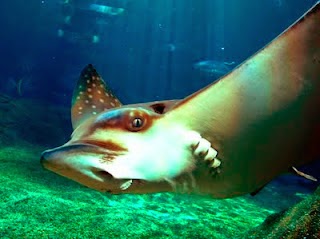
rays,
Hiding mussels and urchins in the sand for these guys makes them look for their food the way they would in the wild.  Very entertaining for the public!
and other amazing animals.
See the pink wormy thing on his head?  That's what he uses as bait.  He wriggles it around to lure food fish closer and when they're close enough...he gobbles them up.
The musselcracker...boy, does this guy have some serious teeth!
A pop-eyed scorpionfish.  They sit so still and then when prey swim by, they're lightning fast!
Enjoy visiting your local aquarium and checking out the hidden lives of all the fishies Sea Fans!  

Chat soon.

Cheers
Abby
}( *)8

Friday, April 24, 2015

Sapphire Coast, Australia

Hi Sea Fans!

Australia is such a beautiful place and the people are so friendly! 
Blue Mountains, New South Wales.  (Photo: Anne Dirkse www.annedirkse.com)
My latest stopover was the Sapphire Coast Marine Discovery Centre (SCMDC) in Eden, NSW, where I was lucky enough to go to the Eden Whale Festival.  I went on a whale watching cruise with Cat Balou in Twofold Bay and was named captain for a day!   


At SCMDC I joined the education programs and chatted to the students about their favourite marine animals.  
In between, I got to know all the animals in the tanks (I got up close and personal with the octopus…I think he liked me. I could sit for hours at the tank just watching him swim and play, they really are amazing animals) 
and discover their marine artefacts.

The staff and visitors were so nice to me and I loved every minute of my visit.   Thanks Jillian Riethmuller for hosting me!! (http://www.sapphirecoastdiscovery.com.au/who-we-are/)

I was sad to leave the coast and all my new friends, but we can always stay in touch through the internet.
So long Sapphire Coast, hello Dolphin Discovery!
This hoodie for a wetsuit was a bit big!

Have a great week Sea Fans!
Chat soon.
Cheers
Abby

}( *)8

Wednesday, April 22, 2015

Waddle you do?

Hi Sea Fans!
Saturday was good fun.  A bunch of my friends joined the Penguin Waddlers in Muizenberg and walked 15km to Simonstown in the Cape (South Africa) for a good cause...African Penguin Awareness.  

The hard core waddlers started their 124km route in Gansbaai... 

The Waddle for a Week (13 – 18 April 2015) is an annual event that brings together committed, conservation-minded people keen to raise awareness about the plight of the African penguin. 
There used to be lots of African penguins, but now they're endangered.  (Some scientists reckon that they could become extinct within the next 20 years because of a huge drop in the number of breeding pairs!).


All it took was a few aquarium staff to get this, now much-anticipated annual event, going.     The waddlers walk not for money, but for the love of these amazing animals!  Yes, all they want is for people to show their love for the penguins and the planet. 
Pedestrians, cyclists and onlookers of all sorts are informed about the Penguin Promises campaign as the waddlers walk along the coastline.  The campaign aims to get people promising to do something for the planet’s future, why not pledge your promise? 
Examples: 
·        Don’t buy plastic shopping bags – reuse quality fabric bags
·        Make a pact to be involved in at least one environmental day this year -  What about Earth Hour?!
·        Stay informed about the Penguin - The more we know, and share with others, the greater the chance of people effecting social change.

·        Get involved in coastal clean ups - Litter in our oceans is a threat to the Penguins. If you don’t live on the coast arrange a waterway clean up in your area.

For more info go to: www.penguinpromises.com

Have a great week Sea Fans and don't forget to pledge...not just South Africans!

Cheers
Abby
}( *)8

Monday, March 23, 2015

Mermaid.....'s purse

Hi Sea Fans!

I've been really busy setting up a new exhibit for the shark section and came across a lady who does something very interesting.  But let me give you a bit of background first...

Sharks keep our largest and most important ecosystem healthy…our oceans.  
Leopard catshark. Photo: (WT-shared) Pbsouthwood at old wikivoyage wts
Being at the top of the food chain in the marine environment, they help to keep fish stocks in the ocean healthy.  As our oceans cover over 70% of the earth’s surface and houses 80% of life on earth, maintaining (preserving and not destroying) this ecosystem is really really really important to life on earth! 

By monitoring (keeping an eye on) and understanding local shark species and what they need in order to do well, we can actually help to protect our natural heritage.  How, as average people who haven't studied science, can we help?  You just have to be willing to help... and you can be a citizen scientist!

Citizen science (CS) is scientific research done by non-professional scientists…Joe Blogs the lawyer, or Betty Boop the PA, for example.  Anyone can get involved in CS projects!

An example of a CS project that I came across was a shark egg case project run by Sheraine van Wyk on the Whale Coast in South Africa.  Regular shark egg case collections by volunteer groups along the Whale Coast shoreline,  provides information on the egg cases found at different beaches. This gives an idea of the shark species that occur offshore at those areas.

About 25% of all sharks reproduce (have babies) by means of an external egg.
These are the sharks that the Whale Coast Conservation project focusses on.

The eggs have different shapes, sizes and colours, but what makes shark eggs unusual-looking is that many have tendrils or hooks with which they attach to sea plants, rocks or other objects under water. 
Inside the egg the embryonic (baby) shark feeds off a yolk sac for up to nine months while it grows and develops.
Photo: Sander van der Wel
When ready, the mini shark hatches from the egg leaving the empty egg case behind.

The empty egg cases usually wash out of the sea and end up on the beach. If these ‘mermaids’ purses’ are found at a certain beach it indicates that the adult sharks or ‘parents’ are in the water nearby.  Scientists working on some of these types of sharks have already found that eggs are shed continuously throughout the year, except for one shark.   The St Joseph shark seems to do things a little differently because more of their eggs are found on the beaches at certain times of the year.  
St Joseph's shark. Photo: L. Barker from the Two Oceans Aquarium.
More research is needed to find out exactly what's going on.

Egg case collection will continue for a few years, so if you’re interested and in the area, contact Sheraine at Whale Coast Conservation (wcc@ocf.org.za) and lend a hand.

Have a great week Sea Fans!

Chat soon.
Cheers
Abby
}( *)8

Monday, February 2, 2015

Whales and now seals...for free!

Hi Sea Fans!

Remember my visit to WhaleNet with Michael?  Well, there's some great news from Wheelock College. They tagged a Gray Seal on the 19th of January and you can now follow it on their website (http://whale.wheelock.edu/whalenet-stuff/Stop39395-15/) FOR FREE!

Marine mammal researchers are capturing, tagging, sampling, and releasing weaned gray seal pups on islands near Cape Cod and Nantucket. They hope to learn more about the influenza A virus in the gray seal population and fill out a picture of pup movements.  They'll be gathering samples that will teach us more about their health, ecology (ecology = the study of the relationships between living things and their environment), and habitat use (how they move around and what they do in their home area).   Information that they get from the tags will also be used to find out how many males, females, young, sub-adults and adults there are. 

So why not use this pup for your next biology project?  Should be interesting what they find out about this 35kg beauty!

Have a great week Sea Fans!
Chat soon.
Cheers
Abby
}( *)8


Monday, December 29, 2014

Final whale tale

Hi Sea Fans,

This is my last post about my visit with the whale! If you remember, I was in Massachusetts with Cynde McInnis and The Whalemobile. The Whalemobile is a life-sized inflatable humpback whale, modeled after an actual whale that summers off the coast of MA. 
The whale is named Nile, and she was 27 years old this year. Cynde helps keep track of the different whales that come off the coast, and Nile has quite a family (although they rarely ever associate with one another as adults). Her mother Mars, first seen in 1979, has had 10 calves over the past 35 years. Nile was born in 1987 and she has had 5 calves. She had her fifth calf with her this past season. The researchers hope to see Nile’s calf next summer!

I left off the last blog at the point where we were going to go inside Nile! It’s so big when you get inside! When Cynde had the whale made, she had the heart, lungs, stomach, ribs and vertebrae sewn on the inside as well. 
A whole class of students (about 25) can fit inside the whale together. It’s a little dark so Cynde has a flashlight and uses it to point all different parts of the whale. She starts with the heart. It’s bigger than a big exercise ball, and in a blue whales, it’s the size of a small car! A whale’s heart beat is much slower than humans. The kids clap their own heart beat and then follow Cynde’s clap to illustrate the whale’s heart beat! They always have a look of surprise on their face when they clap every 6 seconds or so.

Next, Cynde talks about the blowholes and lungs. The whale’s lungs are the size of an adult sleeping bag! While in that area, she points out the ribs and vertebrae that go all the way to the whale’s tail, but not in the tail. Finally, she talks about the mouth and how huge it is. Did you know a humpback whale jaw bone is about 8-10 ft long? Put your thumb on your chin and then your index finger on your ear lobe. That’s about how long your jaw is. It’s a lot smaller! When the whales feed, they open their mouths, scoop up huge amounts of fish and water, and then they use their tongue to push the water out through the baleen plates. The fish then go down their throat to their stomach where they are digested. Cynde asks, “Then what happens?”

Poop!! Yes, as a scientist on the whale watch boat, Cynde keeps track of the color of the whale’s poop. What would that tell her? What the whales eat! If they are eating sand eels, the poop is brown, and if they feed on krill, it turns fire engine red! Now, whale poop has gotten a lot of attention in the media lately. Cynde asks, “Does whale poop benefit the ocean at all?” What does a farmer put on his crops? Manure, right? Why? There are nutrients in the poop that help the plants grow. Again, the same thing is going on in the ocean. The whale poop acts as fertilizer in the ocean. The more whales, the more poop, the more nutrients, the more plankton. Now, does phytoplankton benefit humans? Take two breaths. You can thank plankton in the ocean for one of them. They produce over half the oxygen that we breathe on the planet! I loved watching the students put together that whale poop benefits humans! 

The last thing the students did was talk with Captain John who runs the whale watch boat. He talked trash with the students. Well, he talked about marine debris. He shared with them different pieces of trash that are found in the ocean and which animals can be injured by them. Plastic grocery bags are often found in the bellies of whales when they wash up on the beach. Plastic bits can be found in turtles and birds. They talked about recycling and how important that is to be conscious of the choices that we make. Instead of using plastic water bottles, the kids remembered to use reusable ones. Instead of taking those plastic bags from the shop, they talked about taking cloth bags to the shop. It’s so encouraging to ask the students, “Who recycles at home?” Their response is, “Of course!”

All in all, I had a great time with Cynde and Nile and learned so much about whales! Hope you are all having a wonderful holiday and stay tuned for my next adventure!!

Cheers!
Abby
}( *)8