Wednesday, April 30, 2014

Hagfish...dead or alive!

Hi Sea Fans!

Seeing as it is school holidays back home, I thought I'd better blog.  I haven't done much lately on this side except sit in a lot of airports waiting!  So instead of me sending you pics of the airports and me asleep, I thought I'd tell you a story or two about the animals that you may come across at your aquarium.

This same sort of thing has most likely happened at other aquariums so feel free to let me know (by commenting at the end of this blog) if you've had the same response from the public or if you were the public member who thought/said this.  (Don't feel embarrassed, nothing is a stupid question or comment.)

HAGFISH

Hagfish are very interesting, but at the same time boring animals.

Interesting because:

  • They're fascinating eel lookalikes that produce (make) a slime that earned them the Afrikaans name of "Snotvis" ("vis" means fish and I'm sure you can figure the rest out  :))  
  • They eat all sorts of marine animals...dead or alive... and when they do, they make pigs of themselves by burying their faces deep into the carcass/body, forming a tunnel.  
  • They can tie themselves into knots to get out of sticky situations.
  • They don't have any bones!!  Their skulls are made of cartilage.
Boring because:
  • They sit very still and don't do very much unless there is food.  This is why many aquarium visitors think that the hagfish are dead when they get to the exhibit.  They mostly lie motionless on the bottom of the exhibit...not overly exciting, but cool animals if you know what they can do!


TURTLES

Green sea turtle.  Photo: Alexander Vasenin
One of my favourite animals to work with.  They seem so stupid and awkward, but if you have food in your hand, you'll be amazed at what they're willing to do for it!!  Training sea turtles to come to the surface and beach themselves for medical procedures (for the vet to check on them) is actually quite easy.  They aren't always that active on display though and so, like with the hagfish, people mistake them for being dead when they're just resting.  We had a green turtle once that used to lodge itself under the rockwork and people used to think that he was stuck and going to die.  In the mean time, he was "just chilling".

These are just two examples of what people think they see and what's actually happening.  There are so many stories like this, but if the public don't ask, then how will they know?!  Next time you're visiting your local aquarium, don't be shy, ASK!!!  We'd rather have a concerned person asking about an animal than visitors who don't care and just walk by.  You never know, maybe there IS something wrong.  Fish jump, fight, eat each other and do some strange things, so your observations (what you see) may just help us to look after our animals.

Have a great week Sea Fans and those of you that are in South Africa: enjoy the school holidays and visiting your aquarium!

Cheers
Abby
}( *)8

Monday, April 7, 2014

New Aquarium opens - want to find out how all the animals got there?

Hi Sea Fans!

I'm always talking about what goes on in an aquarium and trying to get you behind the scenes as much as possible so here is a clip I came across that tells you more about how new animals are brought into an aquarium:

http://www.kutv.com/news/top-stories/stories/vid_10463.shtml

Enjoy!

Abby
}( *)8

Friday, March 28, 2014

Ocean Explorium

Hey Sea Fans!

My latest stop on my world travels was at the Ocean Explorium in New Bedford, USA!  Thanks to Abbey (cool name!!) and Warren for hosting me, it's always nice seeing more of what goes on at other aquariums.  I got to check things out AND even got to lend a hand...

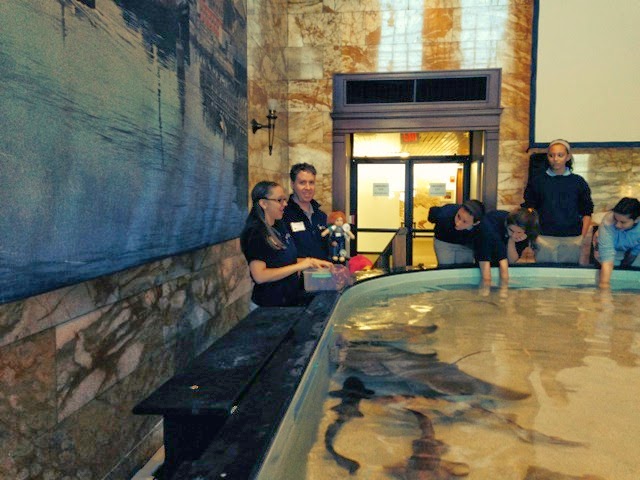
Like at the ray and shark pool where I taught a group of students all about these amazing elasmobranchs:
They loved being able to touch the animals and were amazed at the roughness of shark skin and the smoothness of the rays.  Shark skin is made up of denticles which are like small teeth, so the skin feels like sand paper.

At one of the aquariums that I used to work at, a Snaggletooth shark that had been rescued from fishermen came in and desperately needed some help.  It was so weak from lying still on the sand that it needed someone to help it swim. (Remember that many sharks have to keep moving to breathe!!  As they move through the water, fresh water filled with oxygen flows over the gills so that the shark can breathe.)  I volunteered and believe me, after a few hours, my arm that was around its body felt RAW from the skin rubbing me!!!  Well worth it though, I would do it again in a heartbeat to help these amazing animals!
Feeding time! See how the animals all gathered in the same spot?  They are fed from the same spot each time so they gather there when they see the aquarist ready to feed them.  This is called "conditioning".
One of the most interesting things I got to see was the Coral Farm. This is where tiny little pieces of coral, called fragments, are grown into decent sized corals for sale to hobbyists.  This means that the general public can buy captive grown corals rather than getting them from a place that sells corals collected from the ocean. Another way that aquariums aid conservation and education.
Me holding a coral fragment.
 I couldn't help myself, I just wanted to help out wherever they took me so here you can see Abby Aquarist (ME : )) in action:
Preparing to feed the coral reef tank.
Some new animals were going to be put into the exhibits so I offered to help with this because I know how much time this can take out of an aquarist's day.  New animals need to get used to the water parameters (eg. temperature, pH and salinity) of their new exhibit so water from the exhibit is SLOWLY introduced to them. This is called acclimitisation.
 I'm definitely more a warm water diver, but it was good fun working at the cold water touch tank with a spider crab:
Science on a sphere is a cool interactive they have where you can learn all about any country you like!  If you visit the Ocean Explorium, you must check South Africa, my home country, out and let me know what you found.

So that was my trip in a nutshell.  If you want to experience it for yourself, why not book your tickets today at www.oceanexplorium.org.

Have a great weekend Sea Fans!
Chat soon.
Cheers!
Abby
}( *)8

Monday, March 3, 2014

Shell Recycling


Hi Sea Fans!

Everybody's heard: "REDUCE REUSE RECYCLE" but that's usually when we're talking about paper, plastic and cans.  Now there are people who are recycling a natural resource…sea shells.


For generations, used oyster shells were used to build roads, driveways and for building houses, but now there’s another use for these ugly shells.  Natural oyster shell is the best material on which to grow new oysters and restore oyster reefs. 

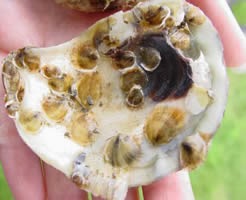
Young oysters (spat) settle and grow on oyster shells. 
The shells can be placed on the bottom of the sea in areas with a natural supply of spat or in tanks with spat so that the young ‘spat-on-shell’ can be moved to the estuaries in restoration programmes.

Oysters and the reefs that they form provide extremely important functions in estuaries. They filter water, removing pollutants, sediment and excess algae; and they help control shoreline erosion (their shape helps reduce wave energy).  As oyster shell accumulates (collects) and builds up into hard sponge-like reefs, they also provide habitat (a home) for other marine animals including fish, shrimp, crab, eels, starfish, mussels and many other marine species. 

Given the shortage of shell, groups like the Oyster Recovery Partnership in the Chesapeake Bay area have developed shell recycling programmes to save this natural resource.
Shells that have been collected from restaurants and the public.
Hundreds of restaurants, caterers and seafood wholesalers are already a part of such recycling programmes.  What can you do?  Well, if you eat out or your mom buys seafood then tell her about the shell recycling and get her to check out the website that has the list of businesses that are members of the shell recycling programme (see http://www.oysterrecovery.org/sra-page/ for a list of members in the Chesapeake Bay area).

Other states have also taken to this idea so take a look, maybe your state has a recycling programme that you can help with:

New Orleans (http://www.crcl.org/)
North Carolina (

When checking out the web, I found a programme in New Zealand (http://www.stuff.co.nz/southland-times/business/7028872/Discarded-oyster-shells-start-new-life) too.  So whether you’re in South Africa, Australia, Europe or Asia, Google it, you may have a programme near you!

Have a great week Sea Fans, enjoy the weather and the snorkelling if you live by the sea in the southern hemisphere!

Cheers
Abby
}( *)8

Thursday, February 27, 2014

Whaling Museum

Hi Sea Fans!

I've been freezing here in the USA, but it's been sooooo worth it!  I've snuggled up inside a whaling museum to get away from all the snow (although making snow angels and having snow ball fights is good fun after everyone's finished work!) so that I can find out more about the job of a museum staff member.

I visited Bob, who's the Science Director at the New Bedford Whaling Museum in Massachusetts, and he showed me around:

This museum is 111 years old and it's the most comprehensive/complete museum devoted to the global story of whales, whaling and the cultural history of the region!!!

The staff at the museum are responsible for preserving (protecting so that it lasts a long time) and cataloging (sorting, labelling and putting everything together in order) the artifacts (objects/items), creating exhibits, 
A ship cutaway model so that you can see all the details inside a real ship.
writing about the history of the area and its connection to the ocean.  They also teach students of all ages (and their teachers).  The museum not only has exhibits that you can look at, but it has a library too which can be used by interns and students from around the world...they've even had some from South Africa!!!

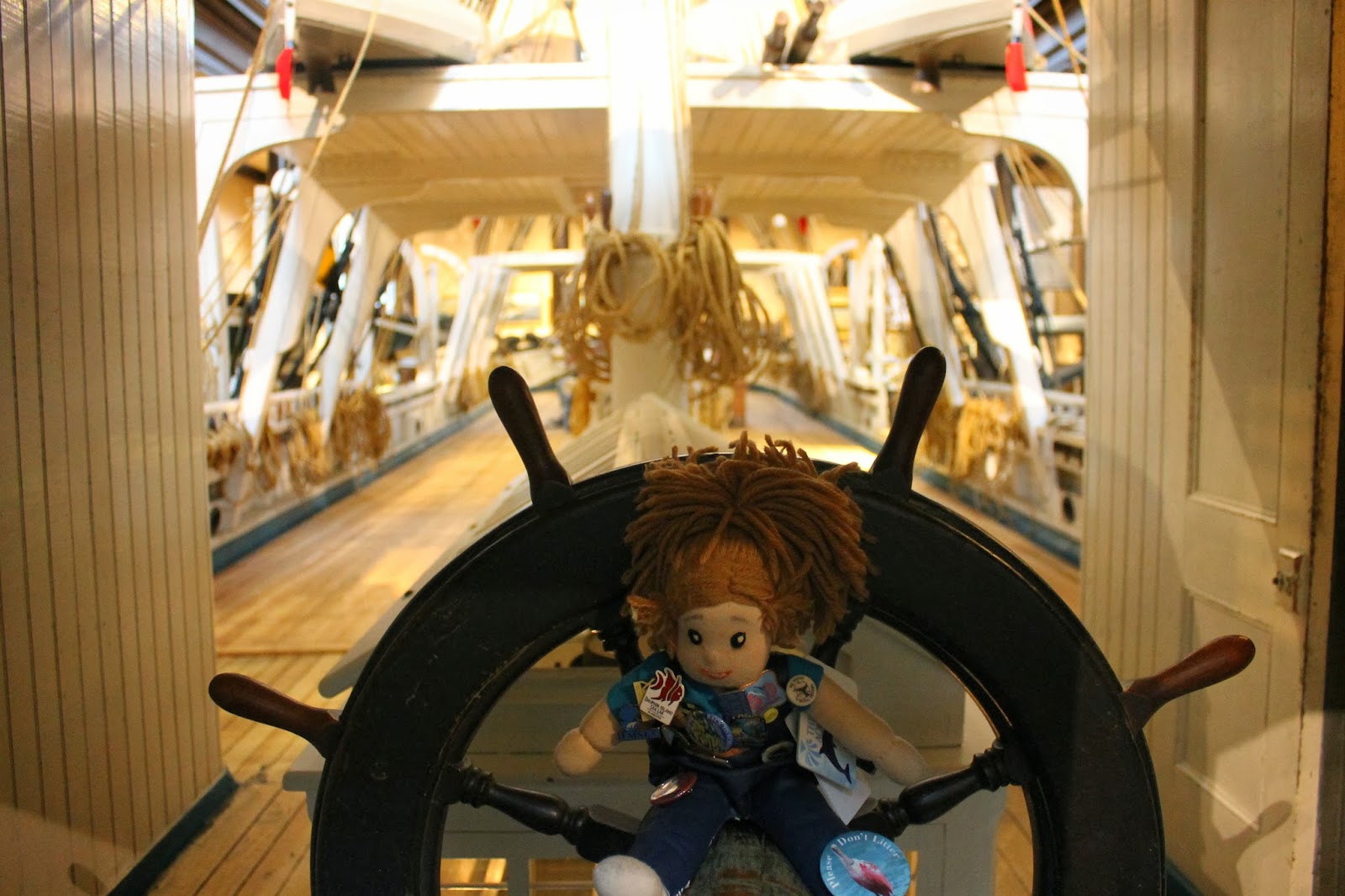
During my visit I've been able to see so much, one of the best things was stepping onto the world's largest ship model called the Lagoda.

It's only half the size of a real whaling ship but boy, was it huge!  I also got to see the world's largest exhibit of scrimshaw. (This is artwork created on hard parts of marine animals...like teeth).  
I got to visit some of the artifact storage, including a large harpoon collection (which haven't been used since the 1920's)
and objects that belonged to whaling families (things like dolls, fine art, furniture etc.).
I even got to sit on the skull of a 14.6m sperm whale.
How cool!

Something which you would expect at a whaling museum is skeletons.   The museum has skeletons of 4 different species which they use to teach people all about whales, whale biology and whale conservation.
Me on a Humpback vertebrae.
While I was visiting, I was also lucky enough to spend some time with students from Rochester while they were learning all about food chains and food webs.

What an awesome visit and what a different kind of marine job!  Did you ever think about working in a museum?  Well, if you'd like to know more about museum jobs, why not visit your local museum and see if they have a marine expert and have a chat to them about their job.

Have a great week Sea Fans!
Chat soon.
Cheers!
Abby
}( *)8

Tuesday, February 18, 2014

Jet setter!

Hi Sea Fans!

It's amazing the places that I've been, the people I've met, the animals I've been able to get to know and the things that I've seen.  Thanks to everyone who has hosted me in their country and hometown, I've had a ball!!  Nope, I'm not done yet, I just want to say thanks to the folks who've been a part of my journey so far:

  • Alaska Fisheries Science Centre (Kodiak Lab), USA
  • Alaska Sea Life Centre, USA
  • Prince William Sound Science Centre, Alaska, USA
  • Two Oceans Aquarium, South Africa


  • Henley Marine Discovery Centre, Australia
  • Tagai State College, Australia
  • Tasmania's Woodbridge Marine Discovery Centre, Australia
  • Naturaliste Marine Discovery Centre, Australia (Perth)
  • Queenscliff Marine and Freshwater Discovery Centre, Australia


  • Veracruz Aquarium, Mexico
  • Shaw Ocean Discovery Centre, Canada
  • California Science Centre, USA
  • Santa Monica Pier Aquarium, USA
  • San Francisco Mobile Aquarium, USA
  • Oregan Coast Aquarium, USA
  • Catalina Island Field Station 
  • Cabrillo Marine Aquarium, USA
  • Joides Resolution/DEEP EARTH Academy (Ship)


  • Wrigley Marine Science Centre, USA
  • Dauphin Island Sea Lab, Gulf of Mexico
  • Florida Aquarium, USA
  • Pier Aquarium, USA
  • Mote Marine Lab, USA 
  • Whale-Net (USA and Australia)
  • Antarctic Research Station


I still have so many more people to visit and countries to see so keep enjoying the ride with me, Sea Fans, it's going to be awesome!


Cheers
Abby
}( *)8

Thursday, February 13, 2014

Cuttlefish Batteries

Hi Sea Fans!
Visiting all these different aquariums and marine facilities makes me appreciate the animals more and more.  One little animal that I've always loved and been fascinated with is the cuttlefish.
Photo: Nick Hobgood
This little guy is not only the beautiful cousin of the octopus, a colour-changing genius and a super swimmer, but it may also be the answer to many a medical problem.  Researchers at Carnegie Mellon University have made an interesting discovery: cuttlefish ink can power tiny electric devices that could be swallowed or implanted in the body!  NO WAY!!!  How cool!!!
Normal batteries can be toxic (poisonous/harmful), but because the cuttlefish batteries use the animal's ink and manganese oxide (also non-toxic), it makes these animal batteries a lot safer for us to use...especially if we have to swallow something like a battery-operated pill that will act as a camera inside our bodies to check things out!
Cuttles are super duper little creatures if you ask me!  Just another way in which Nature shows us the way…
Have a great weekend Sea Fans!
Cheers
Abby
}( *)8