Saturday, September 13, 2014

Cowboy hats and fish surveys for me!

Hi Sea Fans!

In Texas, on my time off I got to wear cowboy hats and when I was "working" I got to wear a life jacket, immersion suit or sunglasses...ha ha ha ha!

While I visited Kelly, I got to take part in a research trip to Flower Garden Banks National Marine Sanctuary. 

I helped Captain Mike pilot R/V MANTA during dive operations at Stetson Bank.
This trip was specifically to collect long-term monitoring data at Stetson Bank. Both researchers and volunteer science divers from Texas A&M University Galveston took part in this trip to collect images and conduct fish and benthic (bottom of the sea) surveys.
Me enjoying the view! (The water in the sanctuary is so much clearer than the muddy coastal water of Galveston.  This is because there are different current patterns in the Gulf of Mexico and because of the sediment load (sandy deposits) from nearshore rivers).
Here are some pics from our trip to show you what the scientists get up to:
"Helping" (more like supervising or just checking things out while others work :)) one of the science divers from the university enter data from his dive surveys into the computer on board R/V MANTA.
Identifying sharks that were spotted on the dive.
Man I love this!  For more information about Stetson Monitoring, go to 
http://flowergarden.noaa.gov/science/stetsonmonitor.html


Have a great weekend Sea Fans!
Cheers!
Abby
}( *)8

PS. All NOAA images credited to NOAA Flower Garden Banks National Marine Sanctuary


Thursday, September 11, 2014

Some more of Texas...

Hi Sea Fans!


I'm still in the land of everything that's BIG and I'm getting to do such cool stuff!!  After visiting OLE and seeing the Oregon II, I visited Kenny Guindon at Katie's Seafood Market in Galveston as his crew offloaded their most recent catch.  Agent Clark talked to them about their trip and sea conditions.
Me with Captain Kenny Guindon.

("Kenny Guindon captains the fishing vessel/boat Falcon from his homeport in Galveston, Texas. As a second-generation fisherman, Guindon has been associated with commercial fishing since 1983 as a commercial fisherman, commercial fishing vessel captain, and Manager of Katie’s Seafood Market in Galveston. He has been the captain of a commercial longline and bandit fishing vessel in the Gulf of Mexico for the past six years".)


Katie's Seafood Market takes part in the Gulf Wild program (http://www.mygulfwild.us/GW/our-story/) that allows the tracking of responsibly-caught and safety tested seafood back to the fishermen who bring it in.  It's quite an amazing system: their uniquely numbered gill tag on every Gulf Wild fish tracks everything: who harvested the fish; where it comes from in the Gulf; and even at which port the fish was landed!  In South Africa we have MSC (Marine Stewardship Council) labels which are similar so if you're a South African wanting to know more and wanting to be able to make a difference, have a look at http://www.msc.org/about-us/what-we-do.

From the seafood market to the classroom...


I helped Kelly Drinnen (my host in Texas and sanctuary outreach specialist) teach a class on reef monitoring for a group of high school students taking part in a Sea Camp program through Texas A&M University at Galveston. 
Examining a series of photos from 2002-2011 from one specific spot at Stetson Bank (in the sanctuary).
Part of the Long-Term Monitoring program at Flower Garden Banks National Marine Sanctuary includes taking photos at the same locations year after year, then comparing the images over time to identify any changes taking place in the habitat. 
Me helping Kelly Drinnen demonstrate how a
T-frame is used to help steady the camera and make sure we take the same picture in the same orientation (position/angle) at the same location (place) every year.

More information on their Long-Term Monitoring program in the sanctuary is available at

and if you'd like a downloadable copy of the Reef Monitoring Lesson, it's available at http://flowergarden.noaa.gov/document_library/eddocuments.html#teach

Hmmm...what fun!  Anyone for some reef research?  Marine biology covers so much!!!

Anyway, I must get going.  Have a great week (end of week) Sea Fans and chat soon!
Abby
}( *)8

PS. All NOAA images credited to NOAA Flower Garden Banks National Marine Sanctuary

Tuesday, September 9, 2014

TEXAS!

Hey Sea Fans!

Yup, I've also been in the state where everything is BIGGER...TEXAS!!!!!  I was lucky enough to be invited to visit the Galveston Lab of NOAA (National Oceanographic ad Atmospheric Administration).  If you want to know more about them, go to: http://www.noaa.gov/

While I was there, I took part in NOAA Observer Training with the NOAA Fisheries staff. 
Inflatable PFD’s (personal flotation device) are an important part of safety.  Making
sure that the hydrostat or soluble pill is in proper working order 
before you leave land is a good idea!
NOAA Fisheries organizes fishery observers to collect catch and bycatch data from US commercial fishing and processing vessels.  The full Observer training is 3 weeks long, but I only had a week so I got a taster of what they get up to. This included mostly safety training because the job requires a lot of time at sea.
I learned how to put an immersion suit on properly and how to look after it. An immersion suit could save your life one day so these things are VERY important to know!!

More information about the NOAA Observer program can be found at
http://www.st.nmfs.noaa.gov/observer-home/

I was also lucky enough to visit with NOAA Office of Law Enforcement (OLE) agent Matt
Clark and made some rounds with him in 
Galveston Bay. 
OLE works to prevent seafood fraud and illegal fishing. They also protect marine resources and their habitat and help safeguard the health of seafood consumers (you and me :)) and the livelihoods of coastal communities.

More 
information about NOAA OLE can be found at http://www.nmfs.noaa.gov/ole/

While checking things out around Galveston Bay, OLE visited briefly with NOAA Ship Oregon II that was docked at Pier 21 in Galveston. Oregon II is a NOAA Fisheries research vessel that operates
largely in the Gulf of Mexico and occasionally makes port in Galveston.  Built in 1967, Oregon II is the oldest research vessel in the NOAA fleet.


For those of you who'd like to know more about what goes on when the ship goes to see for a research expedition, read this: http://www.nmfs.noaa.gov/stories/2013/10/10_18_13photo_journey_fish_survey.html

For the moms and dads who might want to know more about the ship's design, here's a pdf: http://spo.nmfs.noaa.gov/Circulars/CIRC256.pdf


Fascinating stuff!!  And who said that being a marine biologist meant that you just swim with dolphins all day?!?!?  How boring!

I hope you've enjoyed my travels so far Sea Fans because there's still lots more coming...including more from Texas!

Chat soon and have a great week.
Abby
}( *)8

PS. All NOAA images credited to NOAA Flower Garden Banks National Marine Sanctuary

Friday, August 22, 2014

National Insect Day

Hi Sea Fans!

I'm not only getting to see marine life while I'm here in the UK, I'm getting to see some land animals and freshwater life!!

I went with Bella to the Lewes Railway Land Nature Reserve to help with a National Insect Day Event. 
It’s called ‘railway land’ because the land was once part of the railway sidings next to the river. When fewer goods were transported by rail, the sidings were not needed any more. The land was going to be built on but it was rescued and turned into a nature reserve with woodland, ponds, ditches and other habitats. Bella works here at the reserve for part of the time. 

For a while we sat by the Winterbourne stream, 
which is quite low in the summer but the level is much higher in the winter. As we sat and looked up the stream a mother Mallard duck swam past with its chicks.

We had work to do, so we moved on to the peaceful pond in the wood
Leighside pond. 
where we would catch some pond animals and then take them back to the centre. 
Examining our catch.
Bella said we could help Steve show people the pond animals through a microscope that was attached to a lap top and a projector.  The focus was to be on ponds as many of the animals that live in ponds are insects or insect larva. 
Great diving beetle larva.
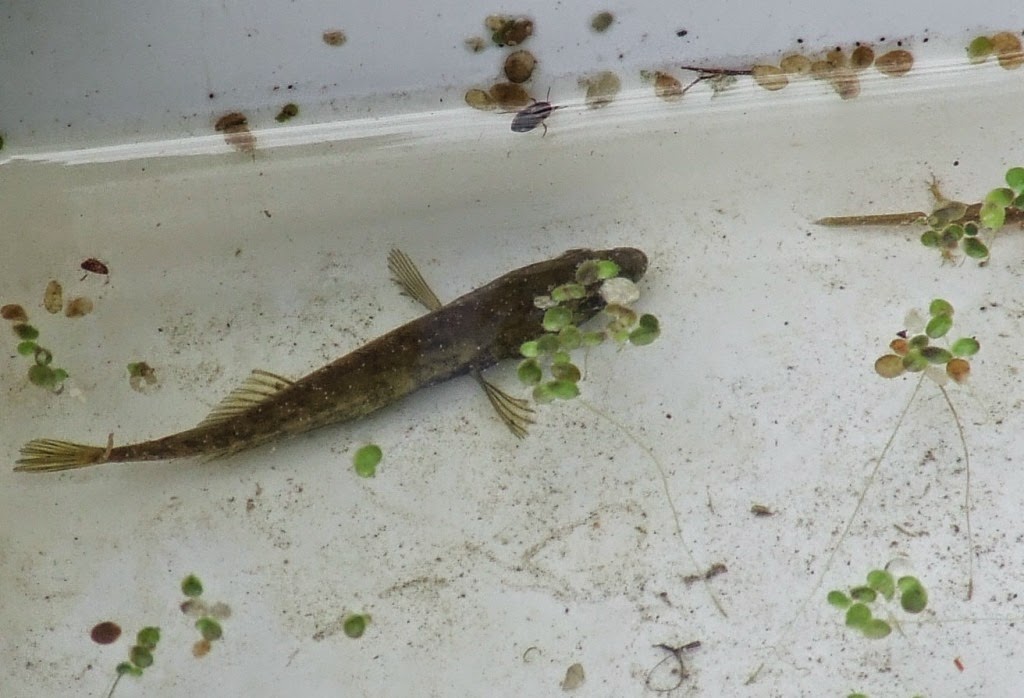
We did catch a few other animals to show including a stickleback fish.  


Bella said that there were eels in the pond and when they were adults they would swim out to the ocean to lay their eggs.

Inside the centre we helped Steve demonstrate the live animals, people had lots of questions. 
Steve explained that many of the animals were insects that breathe air. Some of the animals had breathing tubes which they use like a snorkel at the surface of the pond. Some have gills like fish and others take a bubble of air down with them to use like an aqua-lung (SCUBA diving gear).

People could also see Bella’s display about how freshwater is the most important substance on the planet. The display showed how it is important in nature but also how we all use water and how some people waste it. Bella has also been finding out about parts of the world where drinking water is scarce and people have to walk a long way just for a little water (hmmm...good timing that a South African should visit.  In Africa, there are soooooooooooo many people who don't have running water and they walk miles to get a bucket of water which is used for cooking, bathing and washing).

Bella will soon be travelling to the Amazon Rainforest to find out about this amazing place and also how water is important there too.   I wonder if there's a chance that I could go to the Amazon one day...hmmmmmm.

Thanks so much Bella and Steve, I had fun.

Have a great weekend Sea Fans!
Chat soon.

Cheers
Abby
}( *)8


Tuesday, August 19, 2014

Big Bang

Hi Sea Fans!

I've done so much with Ed the Bear and he keeps showing me more...it's unbelievable what he gets up to!  And people of all ages get to experience it with him.

At the beginning of July, we attended the Big Bang South East Stem Science Event. 
This year they were expecting 4000 teachers and children!  The event shows children lots of different aspects of science, technology, engineering and mathematics and the aim is also to get children interested in a science career when they leave school or university.

I helped with the stand; 
we all wore badges encouraging children to ask us a question. We had lots of information about the science of the oceans, how it creates our climate, provides oxygen, food, freshwater and many other things too, including new medicines.
We also had information about the damage we are doing to the oceans.  Did you know that so far we have only explored 5% of the oceans?!?!? There are so many careers that can help us understand the marine world better: studying marine animals and habitats, oceanography, designing undersea crafts and/or equipment to help us explore the oceans, finding new medicines, or studying how we are damaging the ocean so that we can help repair the damage.

There were lots of questions and the children were very interested to hear about the oceans.  Steve and Ed also spoke about a new project they were hoping to get secondary schools (11-18 year olds) interested in. This is based around a model ROV (remote operated vehicle) that the children can build and then design it to do something.
ROV kit.
This might be to add a webcam and film underwater, it might be to add equipment that takes the temperature of the ocean or collect other information. They are hoping that this could be a good way to get secondary schools to learn more about the oceans.

There were lots of other exhibitors, some had experiments, and others had activities or other information such as Bio care – finding medicines in the ocean, 
a wave experiment.
Learning about waves.
Schools also had exhibits, including a model about renewable energy 
and models made without using plastic.
Model boats made without plastic.
By the end of the day we were very tired but excited that so many children were interested in the ocean. At the end of the day we found out that over 5000 children and teachers had visited. Wow!

A good day I'd say!
Chat soon Sea Fans.

Cheers!
Abby
}(*)8

Monday, July 21, 2014

Bristol Aquarium

Hi Sea Fans!

The UK is treating me well!  I've been all over the place and done so much, I even went to the Bristol Aquarium where a friend of mine used to work.  Thanks to Daniel, the curator, for showing me around!

Here are some pics from my visit:
Meeting a school group.
 I love meeting new schools and it's even cooler when it's the littlies!  So nice to have met you guys.
Taking a seawater delivery for the aquarium.
 Some aquariums make their own seawater, but this is very expensive, it takes up a lot of space and it means some heavy lifting of salt bags!!  It also takes time to mix it and make sure that the mixture is just right.  The easier option, if you live close enough to the sea, is to suck it up and transport it to the aquarium.  Bristol, Dubai and others get it delivered in a truck, the aquariums in South Africa (and others, of course) have a pipe that goes out into the sea and they pump it in directly.

The workings of an aquarium seem so easy from the outside, but when you look at all the little details that have to be taken care of, you realise why it costs so much to run one!!  We love it though!  :)
Hanging around the turtles in the Amazon tank.
 I always love to hang out with the animals when I go to a new facility, they can tell you so much :)  (No, I'm not a fish whisperer, its just that you get to know how to read them.)
Doing a backwash of the sand filters.
Another big job...sand filters come in all sizes, depending on what size tank you have, but some can be HUGE!  and somebody has to make sure that all the filters stay clean so that they can do their job of cleaning the water properly.  There's usually a technical team that maintains (looks after) the sand filters, but the smaller systems are usually looked after by the aquarists who look after the animals in the tank.   So you see, aquarists need to have many talents and learn lots.   No day is the same as another!  :)

So if you want to know more, why not stop your local aquarists and ask them about their jobs!!

Have a great week Sea Fans!

Cheers
Abby
}( *)8


Thursday, July 17, 2014

Dungeness

Hi Sea Fans!

I'm still in the UK with Ed the Bear, checking out the marine life, freshwater life and the surrounds.  I recently travelled with Ed and Steve to Dungeness. Steve spoke to science teachers at a conference while Ed showed me around.  

Ed told me that his beach at Shoreham is made up of shingle pebbles. 
Photo: Dungeness National Nature Reserve
Wave action, called long shore drift, moves the pebbles from west to east. Dungeness is where all the pebbles that the waves move along the beach eventually end up.


We spent so much time in nature, it was fantastic!  We took a close look at the yellow horned poppy, a coastal plant that also grows at Shoreham.
We spotted sea kale, 
Photo: Dungeness National Nature Reserve
Oyster catchers,
a Great Crested Newt, 
Photo: Dungeness National Nature Reserve
and we even saw a Smew when we went to the bird hide!

Smew.  Photo: Dungeness National Nature Reserve
Cool bird, don't you think?!

It's so nice to see such different animals to what we have at home and to learn more about them.  Thanks Ed for showing me around!

Chat soon Sea Fans!
Cheers
Abby
}( *)8